AI shopping agents are changing the e-commerce landscape
E-commerce is facing a turning point. Imagine you have your own personal shopping assistant, a digital agent driven by artificial intelligence, that understands what you need, searches the whole internet for the best options, and can even buy for you. This is no longer science fiction. It is possible today!
In this blog post I look at how AI-based shopping agents are changing the e-commerce landscape, with an eye both on today's trends and on future possibilities. I share concrete examples of what these agents do differently from us humans, what e-commerce players should consider changing, what effects we can expect in the short and long term, and how we can measure the impact.

What is an AI-based shopping agent?
An AI-based shopping agent is simply a computer program (often a chatbot or voice assistant) that can carry out shopping tasks on behalf of a user. Instead of manually browsing categories, reading product reviews and comparing prices, you can describe your need to the agent in natural language. The agent will understand the request, search through enormous amounts of content on the internet or in other available data sources, compare options and present the best choices to you. The agents can be integrated into platforms, like Amazon's AI shopper Rufus, or stand as independent services, like ChatGPT, Perplexity or other similar generative AIs you can ask for recommendations.
What is special is that the AI agent does not just give you a list of hits, the way an ordinary search does. It interprets and summarises the information for you. For example, an agent can answer a question like “Which sound system fits best with a 50-inch TV in a small living room?” directly, with a few concrete product suggestions and reasons, instead of you having to read your way through X different forum threads and Y product pages. With an ever better ability to understand context and preferences, these agents act more and more like a personal shopper who knows you.
How do AI shopping agents shop differently?
What does an AI shopping agent actually do differently (and sometimes better) than if you had made the purchase yourself? Here are some important points:
1. Lightning-fast comparison of options
A human shopper can perhaps compare a dozen products before their eyes get heavy. An AI agent, on the other hand, can analyse hundreds of products against the criteria you have set in a matter of seconds. It reads specifications, prices and reviews at record speed. The result is that you get a much better basis for your decision than if you had to do the groundwork yourself.
2. A deep dive into niche products
Have you ever tried to find a very specific product, maybe a spare part or a unique gift, and felt it was like looking for a needle in a haystack? AI agents are not afraid of this kind of task. Because they can trawl through large databases and catalogues, they can find “gems” among niche products that you or your Google search could easily have overlooked.
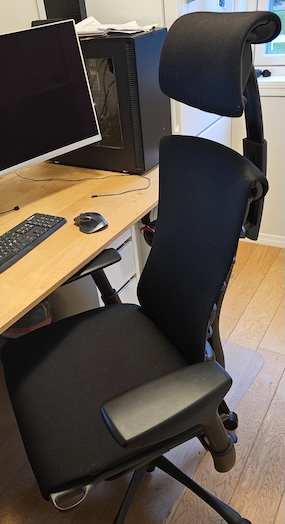
Not long ago I bought an ergonomic office chair. I wanted a quality product, because I spend a fair amount of time in the chair, and I expect to have it for many years. I know little about office chairs, and I know a few wholesalers I have heard about in radio ads. I did not think they presented their products thoroughly enough, and I could not tell the alternatives apart.
When I presented this need to an AI agent, I got several alternatives, with product descriptions and summaries of feedback from users. I ended up with a Herman Miller Embody, a fantastic chair! The ironic thing is that I chose it because I found a local dealer who had it in their showroom, so I could try it. At the same time, I might not have considered it at all if it had not been for the help from the shopping assistant.
3. Objective and free of human bias
We humans are often influenced by bias, consciously or unconsciously. It can be anything from favouring a well-known brand without checking whether an unknown one is just as good, to being misled by glossy marketing. A well-designed AI shopping agent will in principle be more objective. It does not care about brand image or advertising. Only facts. If an unknown brand has better specifications at a lower price, the agent can highlight this, even if you have never heard of it and would not have considered it. It can also avoid common human fallacies. For example, it does not let itself be dazzled by a product being nicely packaged or labelled “bestseller”, unless the product's data actually supports quality.
In short, the agent is immune to hype.
4. Summarises other people's experiences efficiently
Before we buy something, many of us look at product reviews and tests. But this takes a lot of time, and depending on how much we care about the product we are looking for, we do not always prioritise it. AI agents can quickly analyse all the available feedback and extract the essence. They can tell you “90% of the buyers of this vacuum cleaner mention that the battery life is excellent, but a few complain about too much noise”, without you having to read a single review yourself. The agents use product descriptions, FAQs and customer reviews, both from the online shops and from independent forums like Reddit or Facebook, to answer questions like “Is this coffee maker easy to clean?”. This saves time and lets you take in all the pros and cons of a product at a glance.
Shopping agents can do all the preparation
Shopping agents can do all the boring, heavy preparation for you, at a scale and speed no human shopper can match. At the same time they can learn your preferences and give you tailored advice, without falling for marketing tricks. That means you as a consumer can make better decisions in less time. But what about those who run the online shops? How should they deal with this new species of super-shoppers?
Is e-commerce prepared? What shops should do
For online shops and brands, AI shopping agents can feel both exciting and a little unsettling. Suddenly there is an algorithm sitting between you and your customers, filtering away everything it does not consider relevant for the end user. You lose access to valuable tracking data about user behaviour, interests and other profiling data.
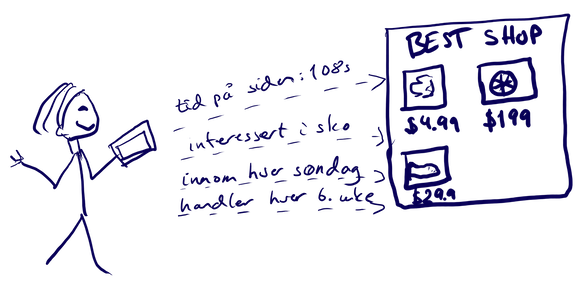
As the figure shows, an online shop can learn a lot about a user through metrics. How long they stay on a product, for example a pair of shoes, can say something about the user being in buying mode for this type of product. She comes back at regular intervals, and buys at a typical frequency.
These patterns can no longer be captured when an AI agent sits between you and the customer.
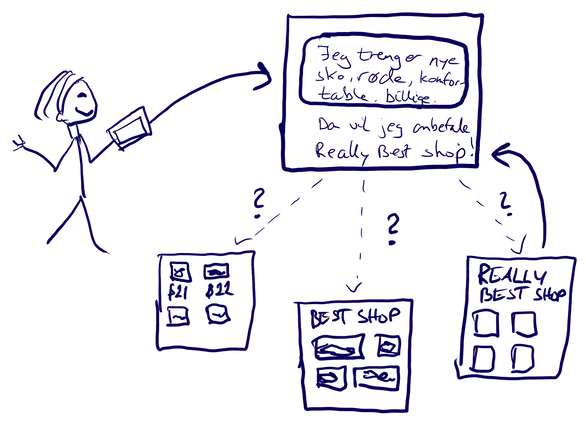
Here the same customer has asked a shopping agent for new shoes, which should be red, comfortable and cheap. The agent visits several online shops, but leaves limited traces. The shops may be able to identify that the visit was made by an agent, but they know nothing about the user behind it, when the next purchase will be, or which products the user is interested in.
What does it take for your products in particular to be chosen by an AI assistant? Here are some changes e-commerce players should consider:
1. Enrich your product data
Shopping agents live and breathe data. The better and more structured product data you offer, the easier it is for an AI to understand that your product fits the customer's needs. This means detailed specifications, high-resolution images, and perhaps most important of all, structured data.
If the agents can read out exact measurements, materials, sizes, compatibility and so on without ambiguity, you are in a stronger position. It can also mean including more context in the descriptions, for example use cases, not just technical numbers. Remember that an AI already pulls in information from product descriptions, Q&A and reviews to answer customers. If these sources are lacking for your products, the agent will have little to go on and may ignore them.
2. Offer open APIs and integrations
Imagine an independent shopping assistant wants to include your online shop in its search results. Will it be able to get hold of the data? Open APIs for product information, availability and prices are becoming increasingly important. Players who want to be visible to AI agents should consider building developer-friendly interfaces that these agents can use to fetch up-to-date information, and perhaps even place orders. We can draw a parallel to how online shops used to have to adapt to search engines. Those who opened up to Google (through SEO measures like sitemaps, structured data and so on) were rewarded with visibility. Now it is time to open up to AI. A Harvard Business Review article calls this “AAO”, AI agent optimisation, and predicts that it will become as important as SEO has been in traditional e-commerce. In other words, you have to make your shop easy for the algorithms to digest.
3. Optimise for the agent, not just for the human
Related to the point above, we should start thinking about how products appear through the agent's eyes. Traditional marketing focuses on what convinces the human: nice pictures, catchy slogans, playing on emotions... An AI cares little about this unless the underlying data and feedback support it. Perhaps we have to highlight objective qualities to a greater extent. If you know the agents rank products by, for example, customer satisfaction, price and quality, the point is to deliver on exactly those factors. It may also become relevant to give feedback to the AI agents. For example, if the agent gives wrong answers about your product, you should have mechanisms to correct them (a bit like handling SEO errors or negative reviews today). We can imagine that just as people once learned tricks to rank high on Google, a whole practice will emerge around optimising for AI agents.
4. Cooperate where needed
Some e-commerce players may build their own agents (the way Amazon has done with Rufus for its platform), but smaller players will hardly have the resources for that. It can therefore pay off to team up with the independent agents that are showing up. If, for example, a popular AI shopping app starts to dominate how people find products, the point is to be represented there. That can mean anything from taking part in open catalogues, joining partner programmes or adapting to standards these agents use. In short, be where the customers are, or the customers' agents.
5. Review your business model
This point is a bit more long-term, but worth mentioning. If AI agents increasingly take control of the customer journey, who “owns” the customer then? Today customers may come straight to your online shop and you can build loyalty. Tomorrow customers may just give their agent some guidelines, “I like brand X, but find the cheapest place that sells it”, and let the agent sort out the rest. Then loyalty may lie more with the agent than with you as a shop. This could force new models, for example shops paying to be recommended (a kind of advertising through AI), or having to compete even harder on price and quality because the agent cuts out the “noise”. Staying ahead and thinking through how your shop can remain relevant, perhaps by offering exceptional quality that the agent values, or unique products nobody else has, will be important.
Observable trends, from Amazon Rufus to ChatGPT as a personal shopper
AI shopping agents are not just theory. They are already here in various forms. Let's look at a couple of real-world examples that illustrate where development stands right now:
Amazon Rufus, your personal helper on Amazon
In 2024 Amazon introduced a generative AI-based shopping assistant called Rufus, built into the Amazon app and website. Rufus lets customers ask questions in natural language while they shop. You can ask “What is the difference between these two TV models?” or “Which hair dryer suits curly hair?”, and Rufus answers instantly and in detail. This makes a gigantic marketplace like Amazon feel manageable for the end user. Since the launch, American customers have taken Rufus into use diligently, and the feedback suggests that people use Rufus as a sparring partner to make better choices. In other words, Amazon has given us a taste of how AI can guide us through an otherwise overwhelming product jungle.
Product recommendations from ChatGPT, the unofficial personal shopper
At the same time, generative AIs like ChatGPT, Gemini and Claude have started to be used as shopping assistants, even though they were not originally made for it. Many have discovered that you can ask ChatGPT, for example, “What are the best wireless earbuds under NOK 2,000 for running?”, and get a good summary of alternatives. What happens then is that ChatGPT has gone through an enormous amount of web content (product data, product reviews, tests, specifications) and makes assessments based on this, against the user's personal needs and preferences. People simply skip the Google search and go straight to the answer. We can already see the trend of using AI directly starting to challenge traditional search engines.
I have used AI agents for shopping myself for several months. It makes me aware of alternatives I would not otherwise have come across, I become more certain that my very specific needs are covered, and I make much better purchasing decisions.
OpenAI has also noted this use and started adding features to make ChatGPT better at exactly shopping. It can look up fresh information online. Earlier there were several plugins that provided e-commerce functions. Plugins have now been discontinued, but solutions like Operator (available in the US) aim to carry out large parts of most purchase flows.
Other players
Amazon and OpenAI are not alone. Google is experimenting with similar concepts through its search engine (for example its AI-driven Shopping Graph and new generative answers in search results). There are startups building “personal shopping bots” for various niches. And in China we have seen shopping agents integrated into super apps like WeChat. The point is that the trend is spreading globally, across platforms. It is probably whoever controls the shopping agent who will control the flow of customers in the future.
Short-term effects, changing purchasing patterns
Already today we are starting to see signs of the shopping agents affecting our purchasing patterns. In the short term, let's say the next couple of years, I expect some clear effects:
Customers take shortcuts in the product hunt
Instead of the traditional customer journey where you search on Google, click into various online shops and read blogs and forums, we see more people going straight to a conversation with the AI to get recommendations. This changes traffic patterns. Online shops may see a decline in organic traffic from Google on typical “best in test” or “which X should I choose?” search terms, because people simply do not search that way as often. At the same time, traffic from new sources may increase, for example clicks from an AI assistant's interface. In practice we may get fewer visits that start on the front page. Instead the user lands straight on a product page recommended by an agent. This means customers use fewer clicks to reach a purchase, and they skip many of the steps we take for granted today.
More accurate purchases and therefore higher conversion
When a customer finally clicks into your shop via an AI recommendation, there is a good chance they are already fairly convinced. The agent may have explained why your product in particular fits. This increases the likelihood of conversion, meaning that the visit leads to a sale, compared with “cold” Google traffic where the customer is still in the research phase. Online shops may therefore see conversion rates shoot up for the traffic that comes from AI agents, even if the volume of such visits is small at first. This can be positive for those who are recommended, since they get more sales per visit. The flip side is of course for those who are not picked up by the agents. They may notice a drop in both traffic and sales without quite understanding why, if they are not paying attention.
AI-generated misunderstandings
In a transition phase, customer service and support functions may get new types of questions. For example: “I asked ChatGPT about this product and it said it could handle water. Is that right?” So the customer arrives with information from a third party's AI that the shop has to deal with. There may be some rounds of clearing up misunderstandings created by AI here and there, especially before the technology is fully mature. Online shops should therefore keep a close eye on feedback. If many customers ask about something odd they “have heard”, an AI assistant may have conveyed something inaccurate, which you should correct by writing it in a way that cannot be misunderstood. Fortunately the agents will probably get better quickly, so this does not become a big, lasting problem.
Early signals in the data
Already in the short term you can start measuring the effects. For example, online shops can track the share of traffic that comes via AI agents. This is not always straightforward, but you can look for certain patterns, such as traffic that lands directly on deep product pages without search referrers, or comes via specific new domains or partners. Some AI tools may identify themselves through the user agent or special parameters. Either way, it would be wise for analysts to create new segments in their web analytics and see whether “AI-referred” visits behave differently from traditional ones. You can also follow conversion rates over time and see whether an increase correlates with increased use of AI among customers (for example through customer surveys asking “did you use a service like ChatGPT before this purchase?”). In short, smart players will start early to measure the effect of the AI agents on their numbers, to adapt proactively.
In the long term, a whole new commerce ecosystem?
If we look a bit further ahead, maybe 5 to 10 years, it gets really interesting. If AI shopping agents become as widespread as many predict, the e-commerce landscape could change fundamentally. Here are some visions of the future and possible long-term effects:
A fully agent-based purchase flow
We may reach a point where the whole purchase journey is automated via the agent. You as a consumer hardly need to lift a finger. Imagine your wardrobe has an AI that knows your style. It suggests new outfits every season, orders samples to your home, and returns what you did not like, all in the background. Or your fridge knows you are out of ham and cheese, and the agent orders automatically. This is the “zero-click” concept, where routine purchases happen without you being actively involved. Even for bigger purchases the agent may do 90% of the job. It finds alternatives, negotiates the price (yes, this was actually a hot topic already in 2006, in my master's studies!), and presents 1 or 2 top choices to you: “Here are two offers on the new sofa you want, and I recommend the first one based on quality and price.” You press “OK” and you are done. The purchase flow is then fully automated, with you only as the decision maker at the end. This will revolutionise the comfort of online shopping, but it will also increase the dependence on the agents actually hitting the mark on our preferences.
Fewer, but bigger marketplaces
When the AI agents take over much of the navigation, there may be a consolidation in where they fetch products from. There are two possible paths here, and it will be exciting to see which one wins out:
On the one hand, the biggest marketplaces and platforms could become even stronger. For example, if Amazon has the most complete product database and the most efficient logistics, many agents will prefer Amazon to ensure quick delivery and reliable service. Then Amazon can grow further, and there will be fewer players overall that dominate (that is, fewer but even bigger marketplaces).
On the other hand, independent AI agents could lead to more competition, precisely because they hop between several shops to find the best deal. An agent is loyal only to its user, not to a particular shop. As one analysis put it , agents can eliminate platform dependence and aggregate data across marketplaces to give the user the best offer, completely without retailer bias.
In such a scenario, smaller shops could get as much visibility as the big ones, as long as they have a good offer that the agent picks up. But even then, distribution may happen through a handful of hubs, for example all the small shops having to be on Shopify, Amazon Marketplace or similar to connect to the agents. So either way I envisage an ecosystem where integration and connections matter more than physical location and marketing muscle. Those who offer the best data and deals win the exposure with AI.
Automated personalisation at a new level
Personalisation in e-commerce is not new. Many online shops try to show you products based on what you have bought or looked at before. But with AI agents, personalisation can reach a whole new level, because the agent follows you, not the shop. Your personal shopping agent will know your preferences across all types of purchases, such as clothes, food and electronics, all together.
Over time it learns what you liked and did not like. It knows your budget, your style and your values. In the long run this can mean that two people searching for the same purpose can get widely different recommendations because the agents know them so well.
The customer journey becomes hyper-personalised. Every suggestion you see is tailored to you. For shops, this means that general marketing measures hit less well, and you may have to “talk” to the agents with personalised content instead.
We go from segmenting in large groups to segmenting down to the individual via the agents. That level of personalisation can increase customer satisfaction (you feel everything is relevant), but we may lose the chance to discover something completely unexpected.
New power relations and intermediaries
If the agents really become the intermediary for most commerce, the question arises: who controls the agent? There is a potential shift of power here.
Today the biggest platforms, like Amazon and Google, but also the Norwegian players Komplett and Finn.no, have a lot of power because customers go directly to them. Tomorrow customers may go to stand-alone AI agents. Then control will shift to those who develop the best agents or solutions for commerce.
Perhaps we will see new “ecosystem wars”, like Android versus iOS, only about AI shopping assistants. Will you use Amazon's ecosystem (where the agent stays within the Amazon universe), or an open agent that assesses the whole web for you? Who owns the customer in this picture? That is an important question.
Some predict that the value chain in retail could be turned upside down, with producers and brands getting a closer, more direct line to consumers via the AI platforms, while traditional retail links become less visible. We may end up with a few AI platforms “owning” customer loyalty, and with shops and brands having to negotiate with them to be recommended, in the same way that we work with search engine optimisation and ads today to show up on Google. The difference is that it could become even more precise. The agent that truly wins consumers' trust will be in the driver's seat.
Consumer behaviour and expectations change
In the long term we as customers will also change the way we think about buying. Tomorrow's buyers may get used to the idea that “if I cannot find it through my agent, I do not care”. We may become more impatient with traditional websites that require us to do the work ourselves.
The threshold for trying new things may get lower when the agent holds your hand, for example trying some new shoes you have never heard of, because the AI says they suit you perfectly. At the same time some of the joy of “shopping around” may change. Perhaps shopping becomes more targeted (the agent takes away much of the random “window shopping” part).
For some this will be a relief, for others perhaps a little sad if you actually like browsing around. Either way, purchasing patterns on a large scale will shift. We may get fewer spontaneous purchases based on the shop's lure offers, and more planned purchases based on actual needs analysed by an AI. From an environmental perspective this could be a good thing!
How we can measure the effect of AI agents
When these changes wash over e-commerce, how can we actually know how big the effect is? Which data and methods can tell us? Here are some approaches:
Share of traffic and sales via AI agents
As mentioned above, it will become important to track traffic generated by AI recommendations. This may take a bit of detective work, but it may get easier over time. If, for example, OpenAI's ChatGPT-Shopify integration is rolled out, Shopify sellers will surely get reports on how much of the sales came via ChatGPT as a channel. Similarly, Amazon could provide figures on how many purchases were initiated via a request to Rufus.
Use the data you have. Create your own tags for special campaigns aimed at AI (for example unique discount codes that only the AI assistant hands out), check server logs for patterns, and do ask your customers. If you send out surveys after a purchase, you can include questions about the use of AI tools during the buying process. If a growing share answers yes, you have a clear indication.
In time, products will probably appear that measure AI traffic in the same way as we know user behaviour tracking today.
Changes in conversion rate and customer journey
Measure conversion rates segmented by different behaviour patterns. Perhaps you see that customers who came in directly on product pages (bypassing the front page) suddenly convert much better than before. That could be a sign that these are no longer random visits, but made by an agent.
Also look at bounce rate and time on page. An AI-referred customer may need a shorter time to think (measured through time on page) because the decision is almost made, while a customer from organic search reads more and takes longer.
Compare new customers against returning ones too. If the agents bring in new customers, they may behave a little differently from loyal regulars.
Customer journey analysis before and after AI can reveal changes. For example, you may discover that for certain product categories people jump straight to “add to cart” without looking at related products or campaigns, perhaps because the agent already told them which product to get. This can be measured by looking at exit rates from product pages, use of the internal search function (perhaps it goes down when people no longer need to search manually on the site), and so on.
As you can see, behaviour tracking will still be important in the time ahead!
Customer satisfaction and return rate
An interesting effect to watch is whether customers become happier with their purchases when they have had help from an AI. In theory, a better match to needs should give fewer returns. So keep an eye on return rates and complaints. If these go down for the segments of customers you know used AI assistance, that is a positive sign.
Customer satisfaction can be measured through reviews. If you see a trend where product reviews more often say “got this recommended by ChatGPT, and it delivers!”, or generally higher ratings, it may indicate that people are buying things that suit them better.
Loyalty can be measured too. Do customers come back more often when they have an AI to help them? Many studies show that people shop more when it is easy to buy.
Market share and agents as a source of leads
At industry level you can follow market shares. If a player that was early with AI adaptation starts to capture market share, you can assume they are riding the AI wave. What do the industry reports say about how many consumers use AI in their shopping? Consulting firms and research firms will surely start to measure this. So keep an eye out for statistics like “X% of customers under 30 used an AI agent to find products in 2025” and similar. Such figures give an indication of adoption in general.
Testing and controlled experimentation
A hands-on way to measure the effect is to run experiments yourself. If you can, try to use the AI agents deliberately and see what it gives you. For example, if you run an online shop, you can try to optimise one product very well for a known agent (do everything you can for ChatGPT to find it for a relevant request from an end user: good data, links in forums, relevant stories about use and which needs it covers...). Leave a similar product as normal. Over time, see whether there is a difference in sales. This can give insight into how strong the effect of AI recommendation is, in isolation.
In the end, the measurements will tell us when AI shopping agents go from being a curiosity to becoming a dominant factor. Those who keep an eye on the numbers will have a head start in understanding and adapting to reality.
Closing thoughts
AI-based shopping agents represent a paradigm shift in e-commerce. As we have seen, they have the potential to make the shopping experience simpler, more efficient and more personal for us as customers. For businesses this means both big opportunities and challenges. There is the opportunity to reach customers in completely new ways, but also the challenge of staying relevant in a world where an algorithm decides which products are highlighted.
The most important thing now is to keep up and experiment. Start using the AI tools that already exist, both as a consumer and as an online shop. Learn how they think. Make a strategy for how you can benefit from them, instead of fighting them. History has shown that technology that makes things easier for people usually wins out, and the AI shopping agent makes online shopping much easier.
It is about us moving towards a world where intelligent assistants and humans shop side by side. Maybe in a few years you will look back on the time before AI the way we look back on the time before the internet today, and wonder how you managed without your faithful shopping agent. Exciting times await both shoppers and sellers!