Psychological safety in practice
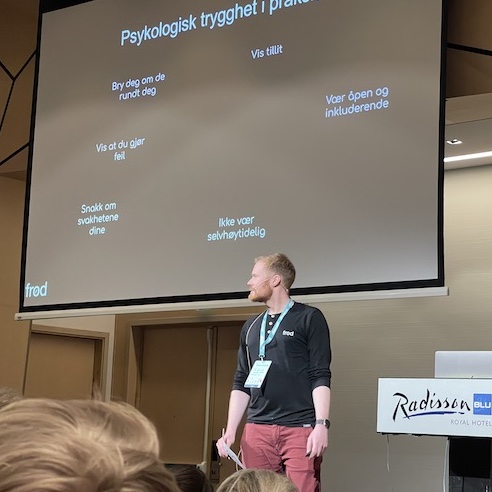
I spoke at Booster in Bergen in 2023 about psychological safety, and about the six tools I use to create psychological safety in the teams I work with. You can watch the video at the bottom of the page.
Why psychological safety
Google's Project Aristotle is probably familiar to many. Its aim was to find out which factors set the best teams at Google apart from the others. The conclusion was crystal clear: psychological safety is the most important factor for how well a team performs. Put another way:
If we want a high-performing team, we have to create the conditions for psychological safety.
So how do you do that? Well, here are the six most important tools that I use.
1. Talk about your weaknesses
Being open about your own weaknesses can seem scary, but it shows your humanity and makes it easier for others to relate to you. For a leader, this can mean discussing areas you are working to improve, which can encourage team members to be open about their own areas for development.
Openness about your own weaknesses creates an environment where continuous development and improvement become the norm. It contributes to a culture where it is safe to ask for help, and where collaboration leads to better quality.
I make a point of telling people about things I cannot do, when I lack the skills, or when I think someone else is better suited for a task. I also often talk about my weaknesses in connection with the next point: don't take yourself too seriously.
2. Don't take yourself too seriously
Taking yourself too seriously can create distance between you and your team. I use humour, often at my own expense. I find that the people around me use more humour too then, often at my expense as well. This breaks down barriers and helps you build solid relationships. Then we have fun at work. That is the kind of environment I thrive in!
3. Care about the people around you
An important prerequisite for psychological safety is showing genuine care for your team members. This means investing time with your colleagues, listening actively, paying attention to their needs and concerns, and showing empathy.
Showing care means more than just listening. It takes active effort to support and help team members. It is about creating a supportive environment where colleagues feel that their wellbeing matters. I really like having regular one-to-one conversations with everyone on the team, and not necessarily only talking about work or professional topics. Following up the people around me is something I prioritise, and if someone is in need, I try to step up as well as I can, also outside working hours.
Showing care for the people around you often has a contagious effect, so that the others also start to care more.
4. Show that you make mistakes
Acknowledging and sharing your own mistakes helps create a culture where mistakes are seen as learning opportunities, not as something to avoid at any cost.
For a leader it can be as simple as sharing a personal story about a mistake and what you learned from it, which can encourage team members to do the same.
By admitting their own mistakes, leaders establish a culture where learning and development are prioritised over blame and shame. This encourages experimentation and innovation, which is essential when you work on complex problems.
Fortunately there is a lot of focus on mistakes now, and on what you can learn from them, and for many people it is perhaps obvious that it is fine to fail. But it is also important that you can ask silly questions, and that you can admit you have misunderstood. There are perhaps shades of mistakes that you can learn from too, and sometimes you have a culture where it is OK to make mistakes, but it still does not feel psychologically safe to ask the silly questions.
You can create safety around failing by avoiding coming across as having all the answers, and instead inviting others into the discussions.
You should also avoid talking too much about goals and tasks, and talk about outcomes and learning problems instead. Goals and tasks are closed. They do not leave room for people's own ideas, whereas when you talk about situations you want to end up in, framed as learning problems, you invite a greater variety of solutions.
5. Show trust
To get people to trust you, you have to trust them! You cannot fake showing trust.
Trust is the foundation for autonomy and ownership. When team members feel trusted, their engagement increases and they will find better and more creative solutions. This often leads to better decisions and higher productivity.
Trust is important in all relationships, and at work it means giving team members freedom and responsibility.
When you are in a leadership role, you can demonstrate trust by handing responsibility over to others and letting them find the solutions on their own, without you interfering. It is about trusting their decisions and judgement. And remember! If they fail, that is allowed; the important thing is to learn from the mistakes!
6. Be open and inclusive
Attempts have been made to measure psychological safety, and if you look at how speaking time is distributed in a group, it has turned out to correlate well. Groups where everyone speaks about the same amount, where all opinions and thoughts are heard, turn out to be safer than groups where only a few people speak. Tracking the distribution of speaking time can be demanding, but it is important to be aware that everyone must be able to get a word in.
Creating an environment where all voices are heard and valued is important, then. This means actively seeking insight and opinions from all team members, especially those who may not take the floor that often themselves.
When you are in a meeting or conversation, it can be useful to take a mental round of the table and think through whether each person has shared their thoughts.
You can also ask questions and invite more ideas and input. Perhaps you can turn directly to those who have been less active in the conversation?
- Now I have got a bit of an overview, but there must still be some angles we have not discussed.
- What is it that we are not seeing here?
- Now we have some good proposals, but I would still like a few more alternatives.
- I would like feedback on the proposal we see as the most promising.
In summary
Creating psychological safety is not only important for achieving results in a team. It is a fundamental human ingredient in good human relationships. It is about developing the relationship between people, based on trust, respect and openness. When team members feel safe, they will more often take initiative, share their unique perspectives and contribute to the team's success. This is especially important in the technology industry, where innovation and quick adaptation are the key to success.
By putting these six tools into practice, leaders can create an environment where team members feel valued, which leads to more engagement, creativity and better results. Remember, creating psychological safety is not only an investment in the team's efficiency, it is an investment in its humanity.
All of these activities are about natural human behaviour. At its core, creating psychological safety is simply about being human!